


When a Loss Feels Final
Imagine entering Wimbledon’s Center Court, the grandest stage in the world, only to leave an hour later after losing 6-0, 6-0. Just a swirl of points going away, no games, no foothold. When Amanda Anisimova faced Igaňątek in the 2025 Wimbledon final, that was her reality. It was more than simply a loss; it was the kind of setback that makes you doubt everything, including your game, your attitude, and even your role in the sport.
Now consider this: would she have believed it if someone had told her during that heartbreaking moment that she would face and defeat the same opponent again in just one month? Most of us wouldn’t. However, Amanda Anisimova’s fortitude came into play at that point. Anisimova’s journey this summer is about more than just tennis; it’s about how someone can use their worst setback as motivation for one of the most spectacular comebacks in recent memory.
We will examine Amanda Anisimova’s resilience path in this post from MyMentalCoach, learning lessons about mental toughness, resilience, and sports comebacks from her Wimbledon struggles to her remarkable US Open triumphs over Igaňňtek.
Wimbledon 2025 Final: The Anguish of a Double Bagel
In sports, there are losses as well as the kind of setbacks that hurt long after the score is erased. That was precisely what happened in Amanda Anisimova’s Wimbledon 2025 final vs Igaňątek. What tennis refers to as a “double bagel” is a straight 6-0, 6-0 outcome. The most biased women’s singles final result in more than a century made headlines for fans, pundits, and historians. But it was much more than just a number to Amanda.
Imagine the scoreboard locked at zero, each game slipping away as you stand beneath the weight of Center Court. Every missed shot seems to reverberate across the globe as the crowd becomes quieter and the cameras go closer. It appears to be dominance on paper. The player on the other side of the net actually feels humiliated by it.
The world of tennis passed judgment. Social media made judgments. Even casual admirers passed judgment. She lost, but it wasn’t just that; it was also how she lost. That’s the brutality of elite athletics: an hour of play can quickly reframe years of arduous effort. For Amanda, it was very personal, even though everyone else referred to it as “historic.” Because she was fighting the idea that perhaps she wasn’t prepared for this stage at all, rather than just losing a match.
The Burden of Self-Doubt and Judgment
Amanda Anisimova left Wimbledon bearing a huge burden of criticism in addition to a heartbreaking score. Even in the quiet corners of tennis commentary, there were murmurs questioning whether she really belonged among the sport’s best. The media headlines were brutal, and fans on social media didn’t hold back. Playing at the top means that when you succeed, everyone praise you, but when you fail, they start to doubt you.
The voice inside her own head, however, could have been the toughest. Every athlete is aware that self-doubt is more pervasive than outside distractions. Amanda must have heard herself ask herself, “Am I good enough?” all the time. Can I manage this pressure? Will I ever recover from being known as the girl who lost a final 6-0, 6-0?
This is when a tennis player’s perseverance is truly put to the test—not on the court with the racquet, but off the court in their thoughts. Because being resilient doesn’t mean ignoring a setback; rather, it means accepting the disappointment and making the decision to go on. In tennis, mental toughness frequently begins during the most depressing and lonely times, when it seems like everyone has given up on you. Furthermore, Amanda’s power came from confronting the pain head-on rather than from pretending it didn’t there.
Lessons from Loss: How She Rebuilt
The fact that Amanda Anisimova chose not to try to hide the Wimbledon final and act as though it never happened is what makes her narrative so compelling. A lot of athletes would. Who wants to relive one of the most agonizing moments of their professional life, after all? Amanda, on the other hand, chose to sit with it. She went over the entire game again, analyzing not only her mistakes but also the reasons behind them. That requires bravery because it’s not just technical but also emotionally taxing to watch yourself get so brutally outplayed.
But she didn’t stop there. She also went back to games where she had excelled, games that confirmed her identity as a player and her potential. This balance was crucial. By analyzing the loss, she was able to pinpoint her game’s flaws. By reflecting on her successes, she regained her confidence. It was a match analysis procedure that evolved into a turning point that brought science and confidence together.
This is what a real comeback story is all about. Learning is the key to resilience, not naive optimism. It’s about clinging to the proof of your strengths while being brutally honest about your flaws. That’s precisely how athletes develop resilience—by turning setbacks into opportunities for improvement rather than by dismissing them. And for Amanda, those introspective hours transformed humiliation into preparation.
Redemption at the US Open: defeating Swiatek
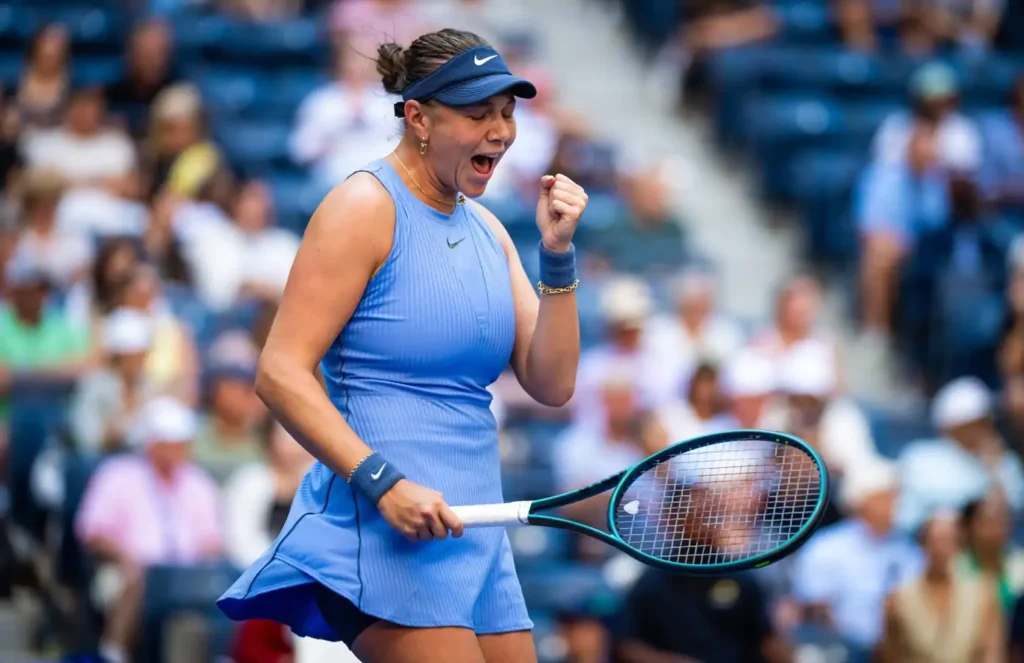
The scenario was set for either redemption or another reminder of grief when Amanda Anisimova entered the US Open quarterfinal against Igaňňtek, the same opponent who had given her that memorable Wimbledon 6-0, 6-0 loss. Amanda changed the course of events this time. She defeated Śětek 6-4, 6-3, playing with composure, accuracy, and a renewed sense of confidence. It was personal closure as much as a victory. It was evidence to her that the humiliation at Wimbledon had been turned into inspiration. Under the lights of New York, the resilience she had been silently developing sprang to life.
However, resilience isn’t just about one outstanding performance. The semifinal matchup with Naomi Osaka served as a test of consistency under duress. The three-set match required every ounce of physical and mental stamina. After losing the first set in a tiebreak, Amanda rallied to win the second in another tiebreak before defeating Osaka 6-7, 7-6, 6-3 in the decider. It was the type of fight that characterizes a player’s spirit as much as their abilities.
These consecutive victories revealed more. Resilience is maintaining your beliefs in the face of adversity rather than just getting back up once. She demonstrated that she could change her story by defeating Čątek. She demonstrated that she could maintain that confidence through another Grand Slam final by defeating Osaka. Together, these games transformed Amanda Anisimova’s summer into a representation of what mental toughness in tennis really looks like—a reminder that comebacks are constructed rather than accidental.
To get a better idea of Amanda’s performance, watch the highlights of her victory at the US Open.
The Resilience Lessons Amanda Anisimova Teaches Us
More than merely a tale of tennis, Amanda Anisimova’s summer of 2025 serves as a training manual for athletes who are resilient. Three important realities are revealed to us by her trip. First, rather than avoiding failure, you must embrace it. Second, both successes and failures provide opportunities for personal development. Third, at the top level, mental toughness—rather than natural talent—is what distinguishes the good from the exceptional. Champions are created there.
Amanda was humiliated and condemned for being on the losing side of a historic score just one month prior. When the US Open rolled around, she was being praised for her perseverance, fortitude, and metamorphosis. Resilience has the ability to transform the toughest criticism into the loudest acclaim.
Her experience serves as a reminder that resilience is about rising stronger each and every time you fall, not about never falling. What’s the good news? Elite athletes are not the only ones with this kind of perseverance. With the correct direction and instruction, you can also develop it.