
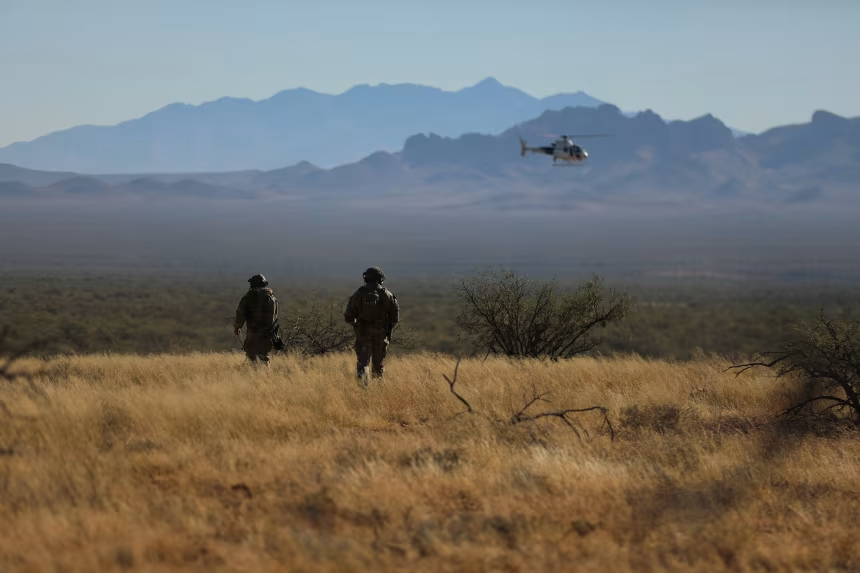
Greg Hess, the chief medical examiner for a county that keeps the most human remains in the country, has spent decades getting used to the large number of bodies that come into his office each year after being discovered in the vast and untamed southern Arizona desert.
The intense heat, severe weather, and difficult terrain of the far-off Sonoran Desert kill travelers. Due to the desert’s proximity to the southern border, Hess claims that the majority of those discovered dead there each year are thought to be migrants.
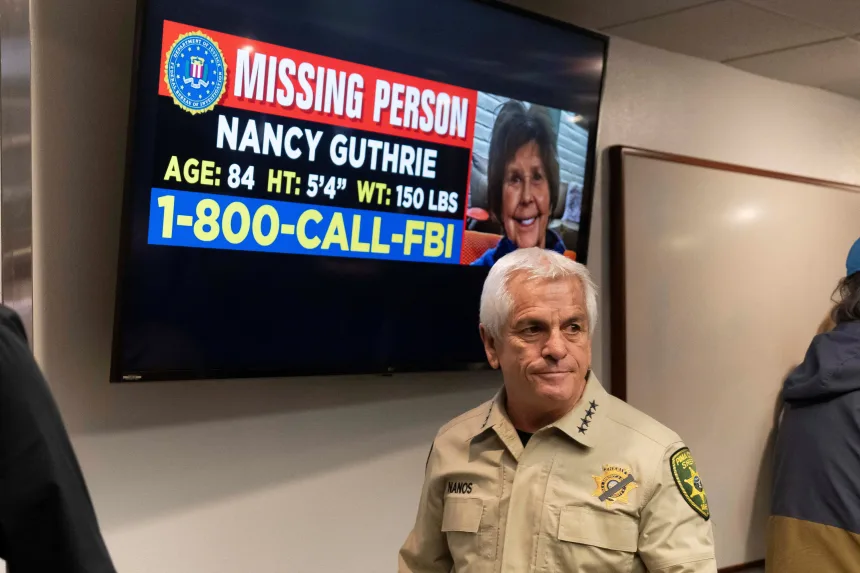
However, Hess claims that since Nancy Guthrie vanished from her Tucson home about seven months ago, the first thing he asks himself when a set of human remains shows up at his Pima County office for analysis is whether they might be hers.
“There’s conjecture that it’s the person everyone’s interested in every time someone finds a body in the wash or somewhere else in southern Arizona over the past few months,” Hess told CNN.
When human remains were discovered in the desert approximately 15 miles from the home of NBC “Today” host Savanna Guthrie’s mother, questions were raised last week.
Authorities did not completely rule out a connection when they announced the discovery, stating that there was “no indication” the remains belonged to Guthrie. When CNN asked the sheriff’s office why that decision was taken, when the remains were discovered, or by whom, they refused.
According to the National Missing and Unidentified Persons System (NamUs), Pima County has long had one of the highest rates of unidentified human remains in the country.
The conditions of the desert itself and the fact that most of them belong to people who traveled from another nation make it difficult to identify remains, which hinders missing persons cases, according to specialists.
According to Hess, decomposition is accelerated by heat, sunshine exposure, monsoons, animals, and other factors. He stated that a large number of the human remains that come into his office are either completely or partially skeletonized.
Since Guthrie’s disappearance, the region has been in the national limelight, which has increased public awareness of the numerous individuals who go missing or die in the vast desert and shows how many families are also looking for answers.
Why finding remains in Tucson is common
Sheriff’s deputies were spotted last Monday at the alleged site of the human remains, which is on a saguaro cactus-covered slope with a view of a busy four-lane highway in southwest Tucson.
One turn off Ajo Way, a road that leads to a few houses with lengthy driveways, is the residential area, which is located outside the municipal limits.
Three months prior, Guthrie’s home was the site of another human remains finding that garnered media attention. As the frantic search for Guthrie continues, investigators continue to perform laboratory analyzes on DNA discovered at her residence.
Experts like Hess believe that many of the human remains discovered in the Sonoran Desert, which spans more than 100,000 miles, are those of humans who frequently perished from dehydration or exposure to other extreme conditions.
Due to the desert’s proximity to the southern border, many migrants have tried to cross it by taking risky backcountry routes, according to the experts.
According to Dr. Molly Kaplan, a post-doctoral scholar at Texas State University who also works for its program focused on border crossing-related deaths in Texas, all four of the land border states—California, Arizona, New Mexico, and Texas—have notably high rates of human remains discovered and unidentified persons cases each year.
According to anthropologists like Kaplan, the deaths in those areas are a “chronic mass disaster.”
According to Bradley Bartos, an assistant professor at the University of Arizona, the majority of the about 150 sets of human remains that Hess claims are found in Pima County each year appear after the monsoon season concludes in late September.
Extreme winds and flash flooding during the monsoon season can shift the remains “down-wash into a more eminently discoverable place” and release them from confined or isolated locations, according to Bartos.